
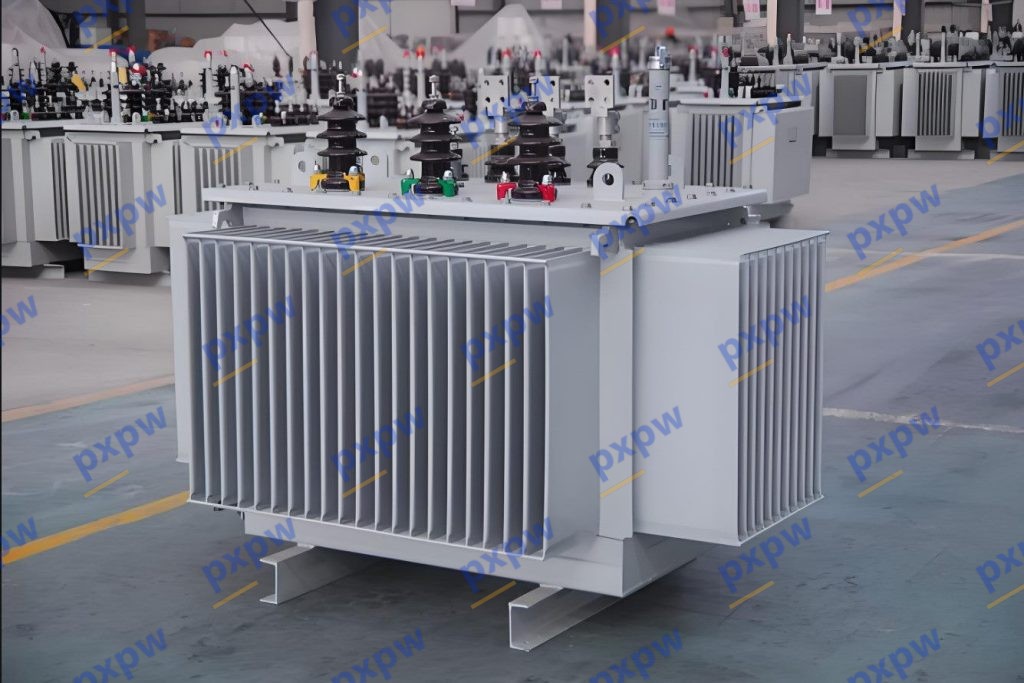
A solid-state transformer (SST), also called a power electronic transformer (PET) or energy router, is a power-electronics-based device that converts voltage and provides galvanic isolation without the conventional 50/60 Hz iron-core and winding structure. As renewable generation, DC data-center loads and microgrids expand, procurement teams increasingly encounter the term SST in supplier literature. This guide explains how an SST works, where it is deployed, and how it compares with the oil-immersed and dry-type transformers used in conventional industrial, commercial and utility projects.
How a conventional transformer works
A traditional transformer steps voltage up or down through electromagnetic induction: two or more windings are coupled by a magnetic core, and voltage changes with the winding ratio at line frequency (50 or 60 Hz). It is a largely passive device: no control software is required for basic voltage conversion, and its insulation is either mineral oil in an oil-immersed unit or cast resin in a dry-type unit. This architecture has a mature global supply chain and remains the standard choice for grid-frequency distribution, substation and industrial power duties.
How an SST works
An SST replaces the single magnetic-coupling stage with a power-conversion chain built around semiconductor switches and a high-frequency transformer. A typical arrangement has three stages:
- Input AC/DC conversion: the grid-side AC is rectified to a DC link.
- Isolated high-frequency DC/DC stage: semiconductors such as IGBTs, silicon carbide (SiC) or gallium nitride (GaN) switch at high frequency; a high-frequency transformer provides isolation and voltage matching. Operating at high frequency reduces the size of the magnetic core compared with a line-frequency unit.
- Output DC/AC inversion: the inverter returns regulated AC to the load, or supplies a regulated DC bus where the system architecture calls for one.
A digital controller (DSP or FPGA-based) manages switching, voltage, reactive power and fault response. Because the conversion is active, an SST can support bidirectional power flow, voltage regulation and power-quality functions that a passive conventional transformer cannot provide on its own.
Where SSTs are being deployed
- Data-center and DC power chains: sites that prefer a DC intermediate bus between utility supply and IT loads.
- DC distribution: modern buildings, industrial campuses and microgrids organizing multiple sources around a DC link.
- Renewable aggregation: collecting photovoltaic, wind or storage outputs before grid interconnection.
- Energy storage interfacing: linking battery systems with the grid or local load.
- EV fast-charging hubs: high-power charging where compact, controllable conversion equipment is valued.
- Traction and transport power: some rail and mobile power applications exploring solid-state conversion.
Reported advantages
- Compact footprint: high-frequency operation generally reduces magnetic-core size and weight, although the converter cabinets, cooling and protection equipment still occupy space.
- Bidirectional power flow: suited to storage, renewables and vehicle-to-grid style arrangements.
- Active power control: voltage regulation, harmonic mitigation and power-factor support can be handled inside the converter chain.
- Digital monitoring: operating data, faults and configuration can be read and adjusted through the control system.
- Multi-port integration: several sources or storage links can be managed around a common DC bus.
Footprint, efficiency and reliability figures vary by topology, semiconductor generation, cooling design and vendor. They should be checked against the actual project duty cycle rather than taken as a general SST specification.
Limits and barriers
- Higher upfront investment: semiconductors, control hardware and cooling typically cost more than a conventional transformer of the same rating.
- Thermal and stress management: high-frequency switching places sustained thermal and electrical stress on semiconductor devices; cooling and derating must be engineered carefully.
- Auxiliary dependence: the system relies on control power, firmware, communication links and spare-part support.
- Standards and field track record: at medium and high voltage, SST standards and long-term operating history are less mature than those of conventional transformers.
- Not a like-for-like replacement: an SST does not automatically replace every distribution or substation transformer.
SST versus conventional transformer
|
Aspect |
Conventional transformer |
Solid-state transformer (SST) |
|---|---|---|
|
Voltage conversion |
Magnetic coupling at 50/60 Hz through core and windings |
Semiconductor switching plus a high-frequency transformer in a multi-stage chain |
|
Control |
Passive; basic voltage conversion only |
Active digital control of voltage, flow direction and power quality |
|
Power flow |
Generally one direction |
Designed for bidirectional flow where required |
|
Insulation medium |
Mineral oil bath or cast resin |
Solid-state conversion stage; no oil bath in the core conversion path, though auxiliary cooling may be liquid in some designs |
|
Footprint |
Larger magnetic assembly |
More compact magnetic core, balanced by converter and cooling cabinets |
|
Maturity and supply chain |
Mature standards and broad global supply |
Emerging technology; fewer suppliers and shorter field record at higher voltages |
|
Typical upfront cost |
Lower |
Higher |
|
Best fit |
Grid-frequency step-up/down for industrial, commercial and utility distribution |
DC-heavy, multi-source, digitally controlled power systems |
What this means for procurement
For typical 50/60 Hz distribution, substation and industrial supply duties, proven oil-immersed and dry-type transformers remain the mainstream choice. Our current range covers:
- Oil-immersed main power transformer for power stations and large substations
- Oil-immersed distribution transformer for power distribution networks
- Cast resin dry-type transformer for indoor and environmentally sensitive installations
- Integrated energy storage converter and step-up transformer unit
If your project involves a DC bus, a multi-source microgrid or a fast-charging hub, ask the equipment supplier to specify whether an SST, a conventional transformer paired with separate power converters, or a hybrid arrangement best fits the single-line diagram, duty cycle and budget.
Common questions
Is an SST replacing traditional transformers?
Not broadly yet. Conventional transformers remain standard for most grid-frequency applications; SSTs are targeted at specific DC-heavy and actively controlled systems.
Does an SST use transformer oil?
The core conversion stage is solid-state and does not rely on an oil bath. Some designs still use liquid cooling for auxiliary equipment, which should be confirmed in the vendor specification.
Can you supply an SST for my project?
Our published range currently covers conventional oil-immersed and dry-type transformers, integrated storage units and diesel generator sets. Share your single-line diagram, voltage levels, capacity and duty requirements through the contact page, and our engineering team will advise on the conventional equipment that fits the installation.
Explore the product range or request a quotation for your transformer specification.